
What actually comes off a hull when it's cleaned?
C-Leanship commissioned independent laboratory testing of waste collected during a hull cleaning in Singapore. The results reveal heavy metal concentrations and microplastic loads that demand a serious conversation about how we, as an industry, handle what is removed from ships.
Hull cleaning should be a routine part of ship maintenance. It reduces drag, cuts fuel consumption, and helps prevent the spread of invasive species. Depending on the technology used, the waste removed from the hull can either be captured and responsibly disposed of onshore or released directly into the surrounding water.
“But what actually comes off the hull is a
question the industry has largely avoided.”
What we found in the waste
We benchmarked the sample against internationally recognized thresholds. For heavy metals, the reference point used is the NOAA Sediment Quality Guidelines (Effects Range-Median, or ERM), the US National Oceanic and Atmospheric Administration’s globally applied standard for assessing toxicity thresholds in marine sediments.
428×
the NOAA toxicity threshold for copper
Copper concentration: 115,524.7 mg/kg (NOAA ERM: 270 mg/kg)
84×
the NOAA toxicity threshold for zinc
Zinc concentration: 34,397.6 mg/kg (NOAA ERM: 410 mg/kg)
96.5 million
microplastic particles per kilogram of collected waste
Dominated by acrylates, polyurethanes, and varnish – consistent with antifouling paint polymers
The sample also contained iron (31,498 mg/kg), lead (103 mg/kg), cadmium, arsenic, chromium, and mercury, as well as measurable biological material. Further analysis of the biological material is ongoing, but it underscores a known reality: vessels move marine species between geographies, raising biosecurity risks when this material is not captured.
What these numbers mean for oceans and ports
The NOAA ERM threshold is the concentration above which adverse biological effects are observed in more than 80% of documented cases. A reading of 428 times that level for copper is not a minor exceedance. It tells us that what is being discharged into the water, or allowed to settle on the seabed, poses a significant risk to marine ecosystems.
Copper and zinc are the primary active ingredients in antifouling coatings, designed to prevent biofouling by being toxic to marine organisms. But that toxicity does not disappear when the coating is removed from the hull. It remains in the waste.
The microplastics add another dimension. At 96.5 million particles per kilogram – predominantly paint-derived polymers – the waste carries a significant load of material that has no place in a functioning marine environment.
“The toxicity does not disappear when the coating is removed from
the hull. It remains in the waste.”
An important nuance
These results reflect a specific sample from a specific vessel at a specific point in its maintenance cycle. But hull cleaning waste is not uniform.
On a freshly painted, well-maintained vessel, the antifouling coating is intact and relatively stable. Under those conditions, a quality cleaning system removes biofouling without stripping the coating, keeping waste loads low and the risk profile fundamentally different. This is the outcome proactive maintenance is designed to achieve.
However, on a vessel mid-cycle, where the antifouling has degraded and biofouling has accumulated, the picture changes. As the coating condition deteriorates, significantly more coating material is dislodged during cleaning, bringing with it the copper, zinc, microplastics, and other contaminants. The worse the coating condition, the heavier and more toxic the waste.
This means the environmental risk of a hull cleaning is not fixed. It scales directly with the state of the vessel’s coating and with whether the waste is captured or discharged.
And it means the industry needs cleaning systems that can protect intact coatings and fully capture waste when vessel condition demands it. Not one or the other.
“The environmental risk of a hull cleaning is not fixed. It scales
directly with the state of the vessel’s coating and with whether
the waste is captured or discharged.”
The scale of the problem
Singapore alone sees approximately 5,000 hull cleanings per year. Globally, there are more than 112,500 vessels in the commercial fleet, each typically cleaned at least once annually. That equates to more than 300 hull cleanings taking place somewhere in the world every single day.
Even if only a fraction of those cleanings discharge waste at concentrations comparable to those in this sample, the cumulative environmental load on port waters and coastal marine ecosystems is substantial.
“More than 300 hull cleanings take place somewhere in the
world every single day.”
What this means for the industry
The findings from this study are not just environmental observations; they have direct implications for how hull cleaning is understood, should be regulated, and evaluated across the maritime industry.
Regulatory momentum is already building. Guidance from the International Maritime Organization (IMO) and increasingly strict biosecurity frameworks in markets such as Australia, New Zealand, and, most recently, Brazil signal a clear direction of travel: greater scrutiny of both biofouling management and the environmental impact of in-water cleaning activities.
For shipowners and operators, this introduces a new layer of risk:
- Regulatory risk: Requirements around in-water cleaning are tightening.
- Operational risk: Access to certain ports may increasingly depend on cleaning methods.
- Reputational and ESG risk: As environmental performance becomes more transparent, how a vessel is maintained is harder to separate from how a company is judged.
What has historically been treated as a routine maintenance task is becoming a matter of environmental compliance.
“The industry is moving toward a standard where how you clean
is just as important as whether you clean at all.”
The conclusion: capture should not be optional
“Cleaning without capture is not removing waste — it is relocating it.“
The data from this analysis makes that case in concrete terms. Copper at 428 times the NOAA toxicity threshold. Zinc at 84 times. Nearly 100 million microplastic particles per kilogram. This is what enters the water every time a hull is cleaned without capture.
And this is why capture is moving from optional to baseline expectation. Responsible hull cleaning is no longer defined solely by what is removed from the vessel but by what is prevented from entering the water.
Methodology: Sludge sample collected during a hull cleaning operation in Singapore and submitted to SGS Testing & Control Services Singapore Pte Ltd (SGS Reference: EHS/10618790/26). Sample received 19 December 2025; results reported 3 February 2026. Heavy metal analysis conducted via EPA 3050B/6010D. Microplastic analysis via FTIR microscopy (ISO/IEC 17025 accredited). NOAA ERM values sourced from Long et al., 1995 (Sediment Quality Guidelines).
News
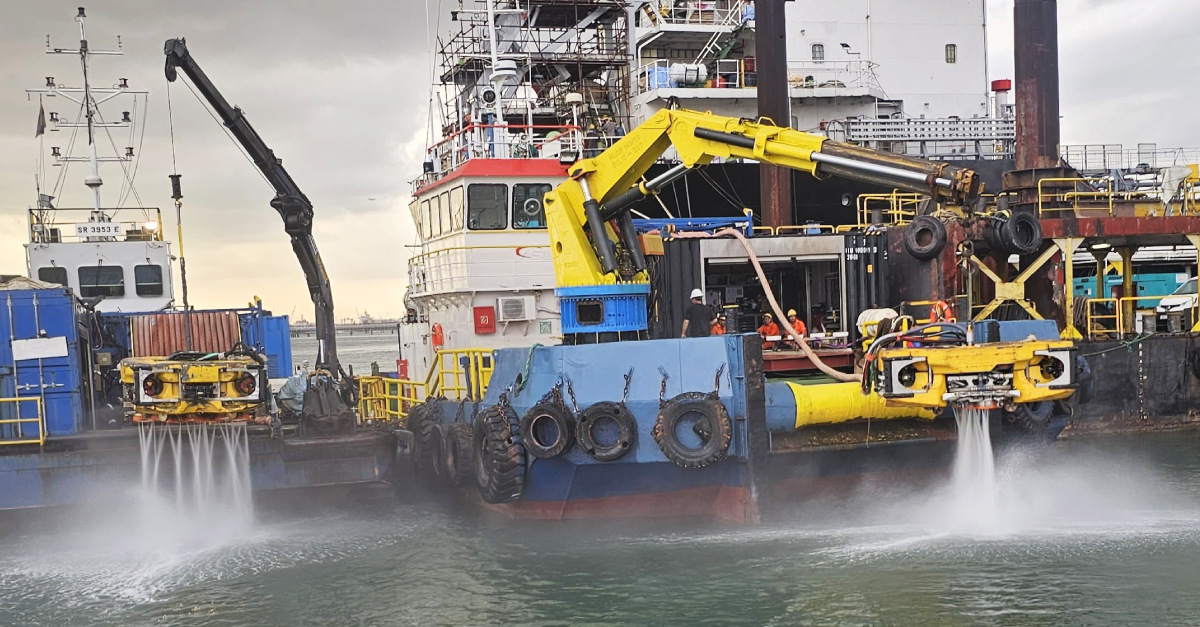
Doubling capacity in Singapore: Meeting the growing demand for sustainable biofouling services
Our second ShipShiner is now fully operational in Singapore, doubling our capacity for hull cleaning in one of the world’s busiest ports.

News
C-leanship welcomes Sanjay Vasudevan as new CEO
We are pleased to announce the appointment of Sanjay Vasudevan as the new CEO, effective 1st February 2025.
Megatrends
Voices from our investors #3: Wallenius
At Wallenius, we have a long history of partnering on sustainable innovations that deliver real impact.